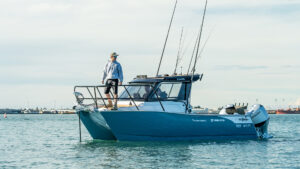

Yes — and the difference is biggest exactly where it matters most: stopped, at drift, with people moving around the boat.
A catamaran hull handles the water differently from a monohull in one fundamental way. Instead of a single hull leaning and rolling around a centreline, two narrow hulls sit wide apart and stay flat. That changes how the boat behaves in every sea state.
It also means a powercat rewards being driven properly. Get the trim right and a cat rides beautifully. Get it wrong and you’ll get the slap people complain about. More on that below, because it’s the single most useful thing to know.
This is where the difference is most obvious, and it’s why most people buy a cat.
With buoyancy carried at the outside edges rather than the middle, a powercat barely rolls when stopped. Someone can move from the transom to the bow without the boat leaning after them. You can land a fish over the gunwale, or get a diver back aboard, without the deck tipping.
A monohull of the same length rolls through all of that. It isn’t unsafe — it’s just constant, and it’s what makes people seasick at anchor.
Short, sharp chop is where a powercat is at its best — and wind against tide is the standard Australian condition rather than the exception.
Two narrow hulls cut into the chop rather than pushing it aside, and air compressing in the tunnel between them cushions what’s left. Trimmed correctly and carried at a decent speed, a powercat will fly over the top of small to medium chop rather than pounding through it.
Cats like a bit of speed. They come alive once they’re properly up and running — most disappointing rides come from a boat that’s under-trimmed, under-powered, or being driven too slowly for the conditions.
Two fine hull entries slice rather than slam, and the tunnel does the rest. The result is a softer, drier ride than a deep-V of the same length taking the same water.
The adjustment for a monohull skipper: a cat doesn’t lean into a head sea. It stays flat and goes through. People often need a trip or two to stop anticipating a lean that never arrives.
A catamaran tracks straight where a monohull can want to swing sideways and broach. The two hulls act like a pair of long keels, holding the stern in line.
For anyone who crosses a bar regularly, or runs home in front of a building swell, that’s usually the characteristic they talk about afterwards. It’s the one that turns a nervous trip into an uneventful one.
If there’s one thing that separates a powercat riding beautifully from one that slaps and wallows, it’s trim. Cats respond to trim far more than monohulls do — and once you know what you’re looking for, it takes about thirty seconds to find.
How to trim a powercat:
What it looks like when you’ve got it right:
Trimmed like that, you’re getting air under the hulls, and the boat is doing what it was designed to do.
Tunnel slap is the most common criticism of catamarans, and it’s worth being straight about: every cat from every builder can slap in the wrong conditions, when a short steep sea gets into the tunnel and meets the underside.
But it’s usually a trim problem, not a hull problem. Too much bow down and the tunnel meets water it should be riding over. Trim the boat properly — bow up, spray off midship — and it largely disappears.
That’s also why a cat that felt “slappy” on a test drive is often a cat that wasn’t being driven right. Worth knowing before you judge one.
Two narrow hulls create less drag than one wide one, so a powercat generally needs less horsepower to hold a cruising speed than a monohull of the same length. Over a long run offshore that shows up on the fuel bill.
Plate aluminium helps here too — it’s light for its strength, which is why every Kingfisher is built from it.
Are catamarans more stable than monohulls? At rest and at drift, clearly — twin hulls carry buoyancy at the outside edges, so the boat stays flat when weight moves around it. Underway they’re stable differently: flat rather than leaning, which most people prefer once they’re used to it.
How does a catamaran hull work? Two narrow hulls carry the boat’s buoyancy at the outside edges rather than the centre, which resists roll. The gap between them lets air compress under the boat, cushioning the ride.
How do you trim a powercat? Start trimmed down, then keep trimming up as you come onto the plane and apply throttle. Trim out until the boat is on the verge of porpoising, then back off slightly. Bow up, spray breaking off midship, no slap — that’s the sweet spot.
Why does my catamaran slap? Nearly always trim. Too much bow down puts the tunnel into water it should be riding over. Trim up until the spray breaks off midship and it should stop.
Are catamarans good in chop? Very. Short, steep chop is where they’re at their best, particularly trimmed properly and carried at a reasonable speed.
Are catamarans good for crossing a bar? They track straight rather than wanting to swing, because the two hulls act like a pair of long keels holding the stern in line. It’s one of the characteristics owners mention most.
Do catamarans make two wakes? Yes — each hull makes its own, and they converge behind the boat.


