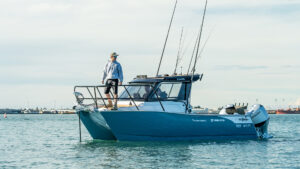
A small power catamaran gives you noticeably more usable deck space and far better stability than a monohull of the same length, because twin hulls carry their beam right forward instead of narrowing to a point. In practical terms a 5m powercat fishes much like a 6.5m monohull — which is why, at the smaller end of the range, a powercat is often more boat for the money.
Kingfisher builds plate aluminium powercats from 3.9m to 5.7m, all single-engine, all built to order and sold through our Australian dealers.
Why size works differently on a catamaran
On a monohull, the front third of the boat tapers away to the bow. You lose it as usable space. A catamaran carries full beam most of the way forward, which is where the flat casting platform comes from — the single most noticeable difference the first time you step aboard.
The practical effect at this size: three people can fish a 5.1m powercat without working around each other. That’s unusual in a boat you can tow behind an ordinary vehicle.
Stability, and why it matters more on a small boat
Stability at rest is where twin hulls earn their keep, and the smaller the boat, the bigger the difference. A small monohull rolls when someone moves; a small powercat barely notices. You can stand on the gunwale, land a fish over the side, or get a diver back aboard without the boat lurching.
For anyone prone to seasickness, or fishing with kids aboard, that single characteristic tends to decide the purchase.
Which size suits you
390 — 3.9m. The outlier of the range: a tiller-steer cat that behaves like a dinghy on steroids. 4mm plate, 250mm draft with the motor up. Lakes, rivers, estuaries and sheltered water.
450 — 4.5m. Inshore and close coastal, and one of the two volume sellers. Available as tiller, side console, centre console or cuddy.
510 — 5.1m. Coastal and moderate offshore, and the one most people land on. Centre console or cuddy. Comfortably fishes three.
570 — 5.7m. Built for offshore. 2.35m beam, from around 1,250kg boat, motor and trailer. As much boat as you can get before stepping up to twin engines.
The honest trade-off
- Single engine. Kingfisher powercats under 6m run one outboard, so you don’t get the get-home redundancy of a twin-engine cat. For inshore and coastal use that’s rarely an issue; for serious offshore work it’s a reason to look at the 670 or above.
What’s different about a Kingfisher small powercat
Every Kingfisher powercat under 6m is fitted with a Wave Breaker — a feature that delivers clean, undisturbed water to the outboard by reducing turbulence between the hulls. Less cavitation, better fuel economy, quieter running. It matters specifically on single-engine cats, which is why it’s standard below 6m and unnecessary above it.
Everything is plate aluminium, built to order, and configured with your dealer around how you actually use the boat.
Frequently asked questions
What’s the smallest power catamaran you can buy? Ours starts at 3.9m — the 390 Powercat, a tiller-steer cat for lakes, rivers and sheltered water.
Are small catamarans stable? Yes, and more noticeably than larger ones. Twin hulls spread buoyancy to the outside of the boat, so a small powercat stays flat where a small monohull rolls.
Can a small power catamaran go offshore? The 510 handles moderate offshore conditions and the 570 is built for it. Below that, think inshore and close coastal.
Do small powercats need two engines? No. Kingfisher powercats under 6m run a single outboard. Twins start at 6m and above, where offshore redundancy matters more.
Is a small powercat better than a monohull the same length? For deck space and stability, yes. For tow width and simplicity, a monohull has the edge.
Where can I buy one in Australia? Through our Australian dealers. Get in touch and we’ll point you at the one nearest you.
Read more